If you build the WIP schedule every month, the EAC vs ETC question is not academic. It is the line that decides how much revenue every active job earned this period. Search "EAC vs ETC" and you get PMP exam prep: earned-value formulas, CPI, SPI, schedule variance. None of it explains the two numbers as they actually behave on a construction work-in-progress schedule, where one of them comes from a project manager in the field and the other drives your percentage complete.
So here is the construction version. ETC (Estimate to Complete) is the cost still required to finish remaining work. EAC (Estimated Cost at Completion) equals costs incurred to date plus ETC. On a WIP schedule, EAC is the denominator that sets percentage of completion, earned revenue, and projected margin for the period. Get the ETC wrong and the whole schedule reports a job that isn't real.
This guide covers both sides of that handoff: the Finance section (how EAC runs the cost-to-cost math under ASC 606) and the PM section (why finance keeps asking you for a cost to complete, in plain English). Numbers below are synthetic — round figures from a fictional general contractor, Meridian Construction Group.
What Is the Difference Between EAC and ETC?
ETC (Estimate to Complete) is the cost a project manager expects to spend to finish the remaining work on a job. EAC (Estimated Cost at Completion) is the total projected cost of that job from start to finish: costs incurred to date plus ETC. On a construction WIP schedule, EAC is the denominator that sets percentage of completion, earned revenue, and projected gross margin under ASC 606.
State the relationship once and keep it: ETC (Estimate to Complete) is the cost still required to finish remaining work; EAC (Estimated Cost at Completion) equals costs incurred to date plus ETC. That single relationship is the engine of the construction WIP schedule.
One distinction matters before the math: in construction cost-to-cost accounting, ETC is not formula-derived. It is the project manager's direct estimate of remaining cost, entered each close cycle, so the WIP reflects current field reality (Foundation Software). The earned-value formulas you'll see ranking for this term come from a different discipline (more on that below).
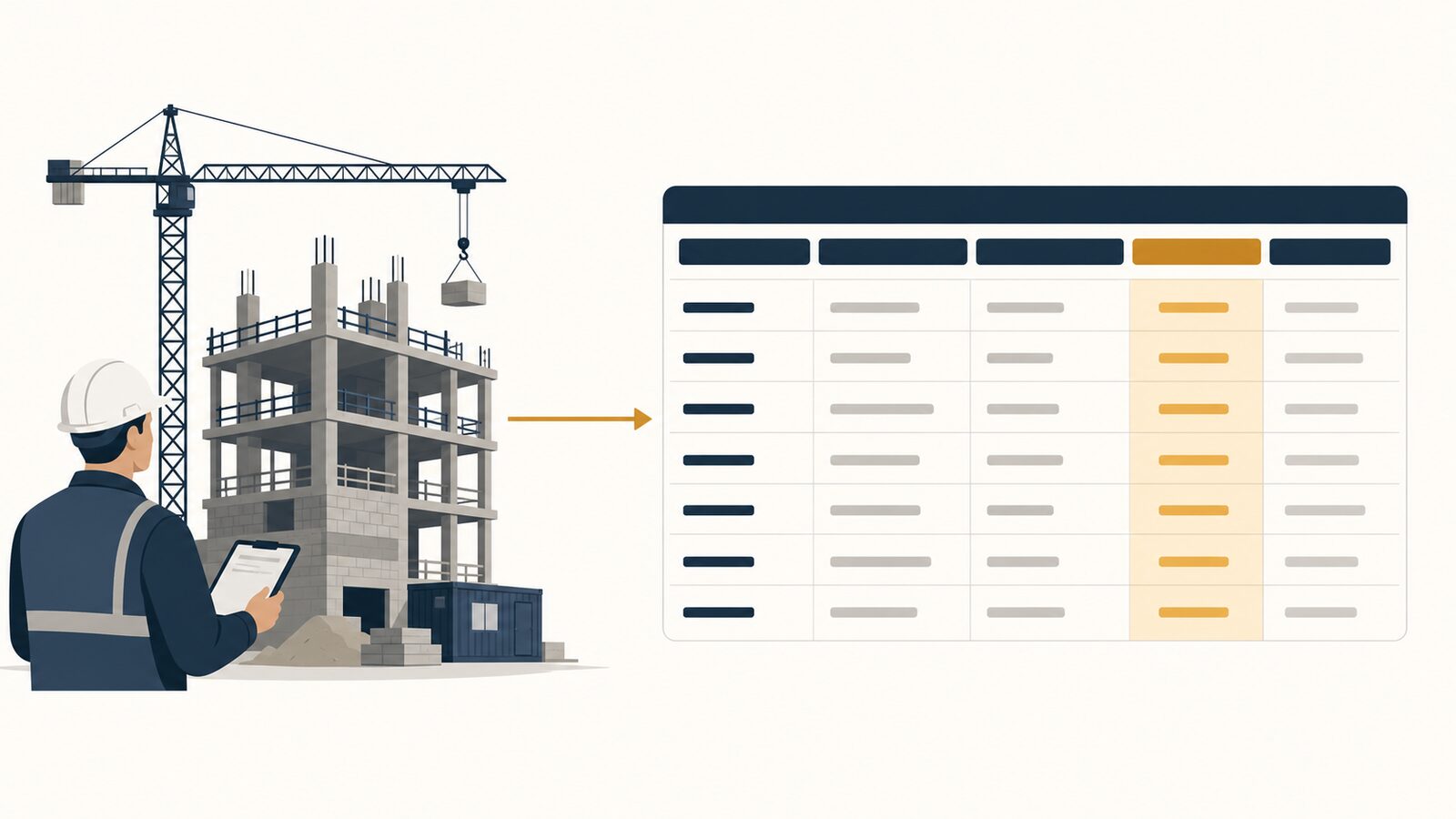
The table below summarizes the key differences between EAC and ETC on a construction WIP schedule.
| ETC (Estimate to Complete) | EAC (Estimated Cost at Completion) | |
|---|---|---|
| What it is | The cost still needed to finish remaining work | Total expected cost of the project from start to finish |
| Formula | PM's direct estimate (human-entered) | Costs incurred to date + ETC |
| Question it answers | "How much more will it cost to finish?" | "What will this job cost when done?" |
| Who owns it | The project manager | Finance / the WIP schedule |
| Why it matters on a WIP | Finance cannot compute % complete or earned revenue without it | Sets % complete, earned revenue, and projected margin for the period |
The rest of this guide takes each column apart: first the EAC side that Finance owns, then the ETC side that the project manager owns.
How Do EAC and ETC Drive a Construction WIP Schedule?
On a construction WIP schedule, EAC is the denominator that produces percentage of completion under the cost-to-cost method, and percentage of completion is what converts a contract into earned revenue for the period. ASC 606 (the revenue standard the FASB issued as Topic 606) recognizes construction revenue over time, and the cost-to-cost method is the input measure most contractors use to track that progress (Foundation Software; PwC Viewpoint). Well over 90% of construction companies use the percentage-of-completion method (Foundation Software).
The chain runs in one direction, and every step depends on the EAC:
- Percentage of completion = Costs to Date ÷ EAC. This is the cost-to-cost ratio, the ASC 606 input measure. Because EAC is costs to date plus ETC, the ETC the PM entered sits inside the denominator.
- Earned revenue = Percentage of Completion × Contract Value. The percentage tells you how much of the contract you've delivered; multiply it by contract value to get the revenue earned this period.
- Estimated gross profit = Contract Value − EAC. What you expect to keep when the job closes.
- Estimated gross margin % = Estimated Gross Profit ÷ Contract Value. The job's projected margin.
- A drop in that projected margin across successive WIP periods is profit fade. Fade almost always traces back to a rising ETC.
Step one is where the cost-to-cost method is fragile. It is an input method, more precise than guessing a percentage by eye, but only conditionally. As Foundation Software puts it, "this method only produces accurate calculations… if estimates are kept current." The estimate kept current is the ETC. A stale ETC produces a confidently wrong percentage of completion, and that error flows straight into earned revenue and margin.
A Worked Example: ETC Changes, and the Whole WIP Moves
Take one job at Meridian Construction Group: Harbor Point Tower, the same job worked through in our over/under billing guide. Contract value is $1,000,000, and costs incurred to date are $300,000. The only number that changes between the two scenarios below is the ETC.
| Original ETC scenario | Revised ETC scenario | |
|---|---|---|
| Contract value | $1,000,000 | $1,000,000 |
| Costs incurred to date | $300,000 | $300,000 |
| ETC (PM's estimate) | $450,000 | $550,000 |
| EAC (costs to date + ETC) | $750,000 | $850,000 |
| % complete (costs ÷ EAC) | 40.0% | 35.3% |
| Earned revenue (% × contract) | $400,000 | $352,941 |
| Projected gross profit | $250,000 (25%) | $150,000 (15%) |
One $100,000 change to the ETC cut the job's projected margin from 25% to 15%. It also pushed percentage complete down: the job earned less revenue this month than last, even though work continued. That is profit fade on a single job, and it is entirely a function of the EAC moving because the ETC moved. Finance did not change a single number it controls; the field did.
Why Does Finance Ask the Project Manager for an ETC?
Finance asks you for a cost to complete because it is the one number they cannot pull from any system. The accounting system already knows what every job has cost so far: labor, materials, subs, equipment, all of it. What no system can know is how much more it will take to finish from where the job stands today. That read only exists in your head and your job-cost gut, and finance needs it to close the books.
So when finance says "ETC," they mean: how much more will it cost to finish this job? Estimate to complete is the formal name; cost to complete is the same thing. It is the one number not already in the accounting system — the project manager owns it, by design.
Here is why that estimate carries weight. Finance takes your number, adds it to costs already spent, and uses the total to calculate how much of the contract the company can count as earned this month. If your number is low (if you forget the change order that's coming, the sub claim that's still open, the rework on the third floor), the job looks more profitable than it is. Then reality lands, costs come in higher than your estimate, and the projected profit shrinks the next time finance runs the schedule. That shrinking margin has a name finance uses: profit fade.
A construction controller described the routine on a finance forum: every month the project managers give a forecasted cost to complete, and finance uses it to build the WIP report that produces the company's earned income (r/FPandA). You are not filling out paperwork. You are providing the input the whole report is built on. One competitor in this space puts the problem plainly: "the biggest limitation? Capturing accurate, structured cost-to-complete inputs from project managers — without which a WIP report is incomplete and unreliable" (PivotXL).
Two practical things keep your number clean:
- Update it when a change order is approved. When a change order is approved, both the contract value and the cost to complete should move. Adding scope to the contract but not adding the cost to finish it is an error that makes the job look more profitable than it really is.
- Add a note. If your number includes a $30,000 contingency for an outstanding subcontractor claim, say so. A quick line of context is the difference between a number finance trusts and one it second-guesses — and it protects you when someone asks about it three months later.
This is exactly the number WIP Ready captures from PMs — on a phone, with no login, in under two minutes, timestamped and attributed — rather than chasing it over email. WIP Ready never calculates the cost to complete for you. It captures the number you enter. The estimate is yours, by design.
EAC vs ETC in Project Management
If you searched "EAC vs ETC" from a project-management or PMP background, you arrived through Earned Value Management (EVM), not construction accounting. In EVM, EAC (Estimate at Completion) is the forecast total cost of the project, and ETC (Estimate to Complete) is the forecast cost of the work still remaining. Both are derived from a shared set of earned-value measures (Wikipedia: Earned Value Management).
The standard EVM formulas, the ones tested on the PMP exam, are:
- BAC (Budget at Completion) — the total budgeted cost of the project.
- EV (Earned Value) — the budgeted cost of the work actually completed.
- AC (Actual Cost) — the cost actually spent to date.
- CPI (Cost Performance Index) = EV ÷ AC — cost efficiency to date.
- EAC = BAC ÷ CPI — used when the current cost variance is expected to continue through the rest of the job.
- ETC = EAC − AC — the cost still to spend, backed out of the forecast.
- ETC = BAC − EV — the simpler variant, used when the remaining work is expected to run at the original budgeted rate.
Here is the point for anyone arriving from EVM: in project management, ETC is a number you calculate from performance to date. Construction cost-to-cost accounting inverts that relationship, and that inversion is the whole subject of the next section on what changes in construction.
EAC, ETC, and EVM: What Is Different in Construction?
Those EVM formulas hold up when cost variance and schedule variance stay statistically meaningful across a large, repeatable scope — software releases, government programs, manufacturing runs.
Construction cost-to-cost accounting does the opposite. ETC is not formula-derived; it is the project manager's judgment, because the denominator (EAC) has to reflect current field conditions on this specific job, not a statistical extrapolation from past performance. The auditor and the surety underwriter will not ask which index you used. They will ask: who gave you that number, and when?
That question is not a formality. In a FASB survey, 48% of peer reviewers said it is a challenge to determine whether management appropriately applied ASC 606 — especially the part about measuring progress (Foundation Software). Measuring progress is the EAC. A current, human-entered, attributed ETC is what makes that measurement defensible.
And the stakes reach past the audit. A surety reads the WIP to judge whether jobs are profitable, billing is accurate, and cost estimates are reliable (Projul). An ETC that keeps climbing on the same job, month after month, tells the underwriter your original estimate was wrong and you are chasing the number — which damages bonding credibility regardless of which method produced it.
Frequently Asked Questions
What is the difference between EAC and ETC? ETC (Estimate to Complete) is the projected cost to finish remaining work. EAC (Estimated Cost at Completion) equals all costs incurred to date plus ETC. On a construction WIP schedule, ETC is entered by the project manager each month; EAC is calculated from it.
How is EAC used in a construction WIP schedule? EAC is the denominator in the cost-to-cost percentage-of-completion formula: percentage complete = costs to date ÷ EAC. That percentage, multiplied by contract value, produces earned revenue for the period under ASC 606.
Who provides the ETC on a construction project? The project manager provides the ETC. It represents the manager's judgment of how much it will cost to complete remaining scope. Because ETC is a forward-looking estimate, it cannot be pulled from the accounting system — the PM must enter it each reporting cycle.
What happens when the estimate to complete is wrong? An understated ETC makes the job appear more profitable than it is. When actual costs exceed the low estimate, the projected margin on the WIP schedule shrinks — a pattern called profit fade. Sureties and lenders watch for repeated fade as a signal of estimating or management problems.
What is the estimate at completion formula? In construction cost-to-cost accounting: EAC = Costs Incurred to Date + ETC. This differs from EVM formula variants (such as BAC ÷ CPI) used in software or government projects, where ETC may be back-calculated from performance metrics. In construction, ETC is always a direct human estimate.
What is EAC vs ETC in project management? In project management (Earned Value Management), EAC (Estimate at Completion) is the forecast total cost of the project and ETC (Estimate to Complete) is the forecast cost of the remaining work. The common EVM formulas are EAC = BAC ÷ CPI and ETC = EAC − AC. In construction cost-to-cost accounting the labels are the same, but ETC is a direct estimate from the project manager rather than a figure calculated from performance indices.
How do you calculate ETC in project management? In Earned Value Management, ETC = EAC − AC, or the simpler ETC = BAC − EV when remaining work is expected to run at the budgeted rate (BAC is Budget at Completion, EV is Earned Value, AC is Actual Cost). Construction WIP schedules skip the formula entirely — the project manager enters the estimate to complete directly each close cycle so the WIP reflects current field conditions.
How WIP Ready helps
EAC vs ETC comes down to one handoff: the PM owns the cost to complete, and finance turns it into percentage complete, earned revenue, and margin on the WIP schedule. The number that breaks most WIPs is the one that lives in the field, not the accounting system, and chasing it over email is why the close takes days. WIP Ready captures each PM's estimate to complete on a phone, no login, timestamped and attributed, then feeds it into a bonding-ready WIP schedule. It never calculates the ETC; the PM owns that number, the way an auditor and a surety expect. For the project manager, that means one honest number entered in under two minutes instead of a week of finance's follow-up emails. For finance, a clean, current WIP gives the surety confidence, and that confidence translates into higher bonding limits (Grit Insurance). See how the workflow runs at wipready.com.