You run the WIP every month, and you already know what profit fade is and how to catch it monthly. This post is narrower. It is about one column on the schedule (the job gain and fade trend on your construction WIP) and how to read it across three or four cycles as a forward signal, not a year-end autopsy.
Most coverage of gain and fade stops at the definition. Gain means margin up, fade means margin down, end of article. That is the floor. The useful skill is reading the gain/(fade) column on a live WIP schedule the way a Controller reads a trend line: direction, magnitude, and slope across consecutive quarters. A single fade is noise. The same job fading three quarters running is a forecast of where it closes out, and the earlier in the job you read it, the more runway you still have to act.
What is the gain/(fade) column on a WIP schedule?
The gain/(fade) column on a WIP schedule is the period-over-period change in a single job's estimated gross profit: this period's projected profit minus last period's. A positive number is a gain: the job's estimated margin improved since the last WIP. A negative number, shown in parentheses, is a fade: the margin eroded. It is computed entirely from numbers already on the schedule, which is why you can read it every cycle without collecting anything new.
The arithmetic is standard ASC 606 cost-to-cost, and you already run it: the gain/(fade) is just this period's estimated gross profit minus the prior period's (Foundation Software). For the full mechanics of how EAC, % complete, and estimated gross profit are calculated, see the calculation post; here we assume you produce these figures monthly. What matters for the column is the one lever that moves it: EAC.
Gain and fade are the industry's terms for the two directions, not vendor coinages. Per Robert Mercado of Marcum LLP: "If the gross profit calculation comes in higher than originally estimated, this is known as a gain. Alternatively, gross profit projected to be lower than anticipated is known as a fade." (Marcum LLP, Construction Business Owner) Gain/fade analysis is a named, standard practice — the construction-CPA association CICPAC teaches the "Profit Gain/Fade Report" for CPE credit (CICPAC). And the operative word in the practice is trend: fade analysis is a trend analysis of a job's estimated and actual gross profit across successive reporting periods, not a single-period snapshot.
How is the period-over-period delta calculated?
Gain/(fade) this period = (Contract value − this period's EAC) − (Contract value − prior period's EAC).
When there are no change orders, contract value is constant, so the delta reduces to prior EAC minus current EAC: when EAC rises, the margin fades; when EAC falls, the margin gains. The single driver is EAC movement, and EAC moves when the ETC moves.
What does job gain mean, and when should it concern you?
Job gain, a positive entry in the gain/(fade) column, means a job's estimated margin improved since the last WIP. It has two very different causes, and only one of them is good news. The first is genuine performance: a favorable buyout, a settled change order, field production ahead of plan. The second is an ETC that carried padding or contingency and has now been relaxed, which lifts the projected margin even though nothing changed in the field.
A gain that follows several fades deserves the most scrutiny. When a PM releases a conservative ETC, the EAC drops and the projected margin rises, a margin movement between periods that is not real improvement. Read every gain against the job's prior slope. Marcum LLP is blunt about why the trend matters more than the snapshot: "A contractor that fades on a consistent basis will most likely render unfavorable determinations from sureties and [prospective] financial lenders." (Marcum LLP, Construction Business Owner)
One term to keep straight, because it is easy to misuse: job borrow. In surety language, job borrow is a cross-job cash signal, not the single-job ETC release above. Per American Global, writing for IRMI, late-stage overbilling can flag "job borrow" — "cash that is represented as overbilling for a project but is, instead, being used to fund a shortfall on another project (or commonly used to cover general and administrative costs)." (American Global, IRMI) That shows up in your billings and working capital, not in the gain/(fade) column. We come back to what the underwriter reads below.
How do you read the gain/(fade) trend across multiple WIP cycles?
You read the gain/(fade) trend by looking at direction, magnitude, and slope across three or four consecutive WIPs — not at any single period's number. One job's fade in one quarter is ordinary variance. The same job fading two or three quarters running is a pattern, and a pattern is what both you and your surety act on. Underwriters say so directly: a margin fade becomes a red flag "particularly if it's more than a one-off and the surety begins to see margin fades as a trend." (American Global, IRMI)
Here is how to read each shape the column can take:
- Single-period fade: ordinary variance. The ETC moved or conditions shifted; monitor it, but do not escalate unless the move is large.
- Repeated fade (two or more consecutive periods on the same job): a pattern. The ETC is drifting up cycle after cycle, so investigate the cause.
- Accelerating fade (the delta growing larger each cycle): urgent. The job is compounding, not stabilizing, and belongs at the top of your triage list.
- Gain-then-fade reversal: the most dangerous reading. Margin appeared to recover, usually from a released ETC, and is now fading from a lower, already-compromised baseline.
- Steady gain: genuine performance improvement or scope-credit capture; confirm the ETC behind it is realistic before you count the margin.
The slope across three or four periods carries more information than any single column value. A job that posts the same small fade each quarter is a different animal from one whose fade doubles each quarter, even when this quarter's number is identical.
Why is the gain/(fade) trend a leading indicator, not a trailing report?
The gain/(fade) trend is a leading indicator because the same fade means very different things at different stages of a job. A 2-point fade at 30% complete and a 2-point fade at 90% complete are not the same risk. Early, the job still has most of its cost runway ahead of it, so a fade left unaddressed has room to compound. Late, the runway is nearly gone, and the closeout margin is mostly locked, for better or worse.
The reason is in the math. EAC is costs-to-date plus the ETC, and the ETC is the only forward-looking input on the schedule. Foundation Software's caution on cost-to-cost is that the method "only produces accurate calculations… if estimates are kept current." (Foundation Software) At 30% complete, roughly 70% of the cost still lives in the ETC — so whatever is driving the fade, a productivity problem or an underpriced scope, has most of the job left in which to keep acting on it. At 90% complete, only about 10% is left to move. Early fade is cheap to catch; late fade is expensive to discover. For what moves the EAC cycle over cycle, the ETC is where you look first.
That is why the trend beats the snapshot. A single late-job WIP tells you where you landed. The trend across early WIPs tells you where you are heading while the destination can still change.
Which jobs should you investigate this cycle?
Not every faded job earns the same scrutiny. Rank them by slope magnitude times remaining cost to run: the size of the fade trend multiplied by the dollars of cost still ahead of you (the ETC), because that is the runway over which the fade can keep compounding. A 3-point accelerating fade on a $24M job that is 60% complete carries far more exposure than a 5-point fade on a $1.5M job at 90% complete, where almost no cost is left to move.
Run the column down your active jobs and the output is a short list: two or three projects to take to their PMs before you finalize the WIP. That is the same position monthly cadence is meant to create: a conversation in week one, not an explanation at year-end. Marcum's "Contract Gain/Fade" guidance frames the goal — when "gross profit expected at completion begins to decrease, it is important to strategize priorities in an effort to restore the original estimated profit." (Marcum LLP, Construction Executive) You can only strategize on jobs with runway left, which is exactly why slope times cost remaining, not raw fade, sets the order.
On a Meridian Construction Group schedule this cycle, that ranking might read: Westgate Logistics Hub first, a 3-point fade that is accelerating, with about $8M of cost still to run for the fade to keep eroding; Northgate Distribution Center second, a smaller 1-point single-period dip, but roughly $15M of cost still ahead of it makes it worth a question; Metro Transit Garage last, a sharp 5-point fade, but at 92% complete there is little runway left to recover it. (Illustrative.)
What does a surety underwriter see in the same column?
Your surety reads the gain/(fade) column the same way you should — as a trend across the WIPs you submit over a bonding year. One fade is noise to them too. A pattern tells the underwriter your cost estimates are unreliable, and that costs you capacity. American Global, writing for IRMI, notes margin fades become a red flag "particularly if it's more than a one-off and the surety begins to see margin fades as a trend." (IRMI)
The threshold is named. Per Andrew Kahn of Concannon Miller, "a fade of 10% or more often results in a call from a bonding agent." (LVB) Old Republic Surety's published analysis makes the same point from the carrier's side: a figure the underwriter watches trend the wrong way across consecutive WIPs gets discounted, not taken at face value (NASBP Pipeline, 2025). A job whose ETC keeps climbing — repeated fade in the column — erodes the confidence that sets your bonding limit. For the full picture of what your surety reads in the WIP, see the underwriter post; the short version is that the trend you read internally is the same trend they grade externally.
Reading the trend in practice: Westgate Logistics Hub across four quarters
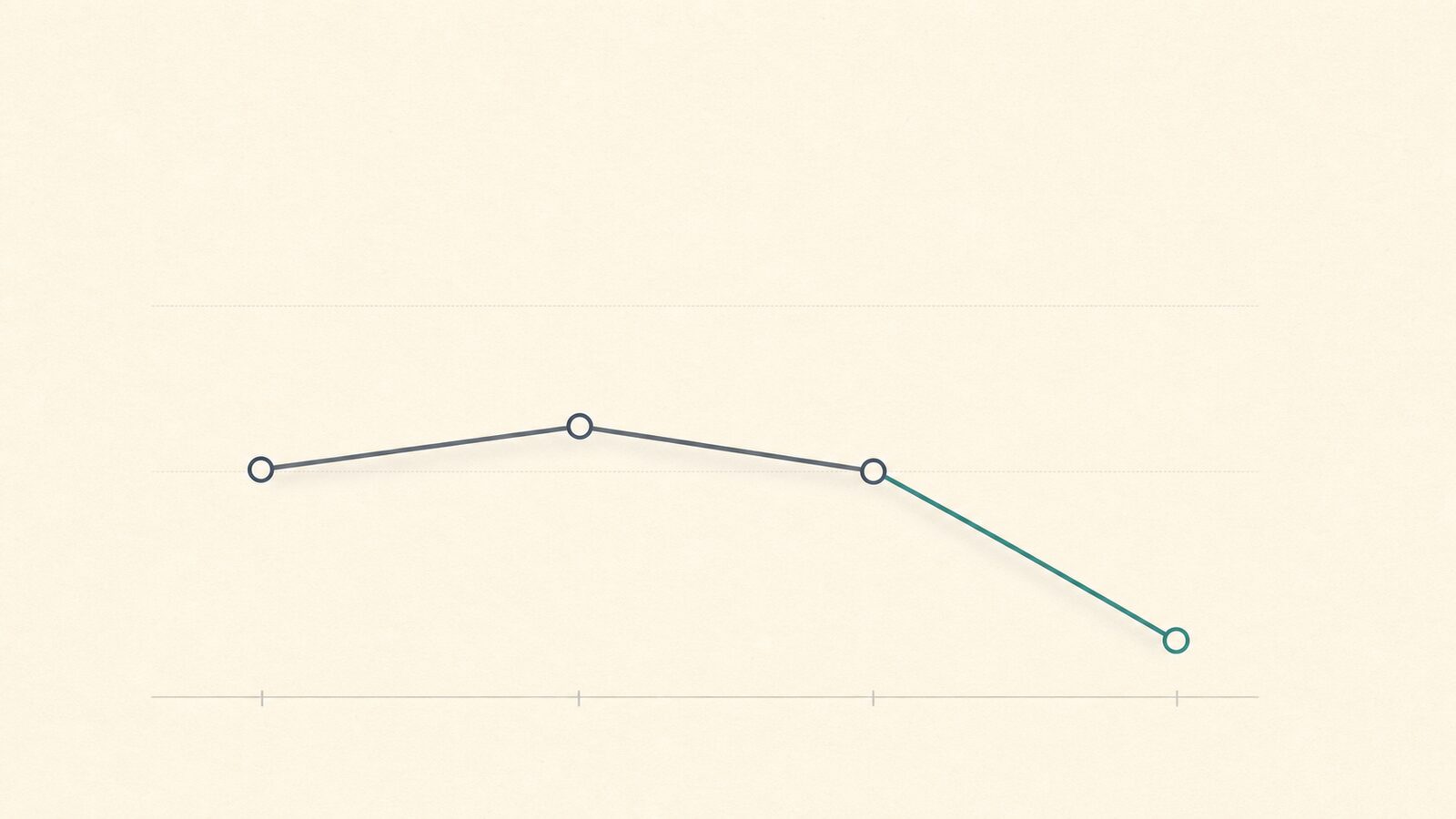
Here is the column doing its job on a single project. Westgate Logistics Hub is a $24M distribution facility run by Meridian Construction Group, bid at a 14% gross margin. Watch the gain/(fade) column across four quarterly WIPs: the job posts a gain in Q2, gives it back in Q3, then fades harder in Q4. That shape — a gain-then-fade reversal turning into accelerating fade — is the pattern you most want to catch early.
| Metric | Q1 | Q2 | Q3 | Q4 |
|---|---|---|---|---|
| Contract value | $24,000,000 | $24,000,000 | $24,000,000 | $24,000,000 |
| Costs to date | $3,120,000 | $6,300,000 | $9,840,000 | $13,200,000 |
| ETC (estimate to complete) | $17,520,000 | $14,100,000 | $10,800,000 | $8,160,000 |
| EAC (costs + ETC) | $20,640,000 | $20,400,000 | $20,640,000 | $21,360,000 |
| % complete (costs ÷ EAC) | 15.1% | 30.9% | 47.7% | 61.8% |
| Estimated gross profit | $3,360,000 | $3,600,000 | $3,360,000 | $2,640,000 |
| Gross margin | 14.0% | 15.0% | 14.0% | 11.0% |
| Gain/(fade) vs prior quarter | — | +$240,000 | ($240,000) | ($720,000) |
Westgate Logistics Hub, Meridian Construction Group — synthetic example, ASC 606 cost-to-cost. EAC = costs to date + ETC; % complete = costs ÷ EAC; estimated gross profit = contract value − EAC; gain/(fade) = this quarter's estimated GP − prior quarter's. Numbers are illustrative.
Read the bottom row left to right. Q2 looks like good news: a $240K gain, margin up to 15%. But the ETC fell by $3.42M that quarter while costs rose only $3.18M, so the gain came entirely from the ETC coming down. Whether that drop was real field performance or just a released estimate, the column alone can't say — that's the question to put to the PM. Q3 hands the gain back: costs rise faster than the ETC comes down, EAC returns to the bid number, and the margin is back to 14%. Q4 is the tell. Costs outrun the falling ETC, EAC passes the bid number, and the margin drops to 11%, a $720K fade, three times the size of the Q3 move. The fade is accelerating, and at 62% complete there is still $8.16M of cost runway for it to keep eroding.
A Controller reading only the Q4 snapshot sees an 11% job. A Controller reading the trend sees where it is headed: bid at 14%, down to 11% at 62% complete, fading faster each quarter with cost still to run. Hold that trajectory and the job does not close at 11% — it lands in the high single digits, several points under bid. That projected closeout, while there is still a quarter to act on it, is the number the trend hands you and the snapshot never will. The Q2 "recovery" was an ETC release, not a turnaround, and the slope said so two quarters before close.
How WIP Ready tracks the gain/(fade) slope between closes
Everything above is the by-hand method: build the WIP, compute each job's gain/(fade), and read the slope across cycles. It works. It also depends on someone finding the time to do it every month, on every job, before the close.
That is the gap WIP Ready fills. WIP Ready reads your Procore cost data and the ETC each PM submits, reconstructs the gain/(fade) column every cycle, and surfaces the jobs whose slope is accelerating — before the close, not during it. It never invents the ETC; the PM who knows the job owns that number, which is what keeps the resulting WIP credible with your auditor and your surety. It is a reporting layer that reads from Procore, not a replacement for your accounting system.
If reading the trend by hand keeps slipping to year-end, see how WIP Ready turns the gain/(fade) column into a standing early-warning at wipready.com.
Frequently asked questions
What is the gain/(fade) column on a WIP schedule? The gain/(fade) column is the period-over-period change in a single job's estimated gross profit — this period's projected profit (contract value minus EAC) minus the prior period's. A positive value is a gain: estimated margin improved since the last WIP. A value in parentheses is a fade: margin eroded. It is computed entirely from figures already on the schedule, so a Controller can read it every cycle without gathering new data. Gain/fade analysis is a named, standard practice in construction accounting — taught for CPE by the construction-CPA association CICPAC as the "Profit Gain/Fade Report" (CICPAC).
How is the period-over-period gain/(fade) delta calculated? Take each job's estimated gross profit this period — contract value minus EAC, where EAC is costs to date plus the ETC (Estimate to Complete) — and subtract the prior period's estimated gross profit. When there are no change orders, contract value is constant, so the delta reduces to prior EAC minus current EAC: a rising EAC fades the margin, a falling EAC gains it. The single driver is EAC movement, and EAC moves when the ETC moves (Foundation Software).
What does accelerating fade on an active job tell a Controller? Accelerating fade — the gain/(fade) delta growing larger each cycle — tells a Controller the job is compounding, not stabilizing, and belongs at the top of the investigation list. It matters most early in a job, when most of the cost still sits in the ETC and the fade has runway to keep eroding the closeout margin. A 2-point fade at 30% complete has far more room to compound than the same 2-point fade at 90% complete, where the closeout margin is largely locked (Foundation Software).
Is job gain always a sign that a project is performing well? No. Job gain has two causes, and only one is real improvement. A gain can reflect genuine performance — a favorable buyout, a settled change order, field production ahead of plan — or it can come from a padded ETC being released, which lifts the projected margin without anything changing in the field. A gain that follows several fades is often the second kind. Read every gain against the job's prior slope before counting the margin (Marcum LLP).
What does a surety underwriter look for in the gain/(fade) trend? A surety underwriter reads the gain/(fade) column as a trend across the WIPs you submit over a bonding year. A single fade is variance; a pattern signals unreliable estimating and lowers the underwriter's confidence in your projected margins. American Global, writing for IRMI, notes margin fades become a red flag "particularly if it's more than a one-off and the surety begins to see margin fades as a trend," and Concannon Miller observes that "a fade of 10% or more often results in a call from a bonding agent" (IRMI; LVB).